Change in Annual Average Temperature (°F) from 1950 to 2006
Except for northeastern Wisconsin, most of Wisconsin has warmed since 1950. Averaged across the state, the warming has been +1.1°F, with a peak warming of 2-2.5°F across northwest Wisconsin. Wisconsin is becoming "less cold", with the greatest warming during winter-spring and nighttime temperatures increasing more than daytime temperatures.
Change in Summer Average Temperature (°F) from 1950 to 2006
Observed changes in summertime temperatures since 1950 have been spatially heterogeneous but have increased by 0.5°F when averaged statewide. The largest summertime warming has been 1.5-2°F over central-northwest Wisconsin.
Change in Autumn Average Temperature (°F) from 1950 to 2006
Wisconsin-mean temperatures have changed the least since 1950 during autumn, with just a -0.6°F cooling. This cooling has reached -1.5°F across northeast and southern Wisconsin.
Change in Winter Average Temperature (°F) from 1950 to 2006
The observed warming since 1950 has been greatest in winter, with an average increase of 2.5°F across Wisconsin. Winter temperatures in northwest Wisconsin have increased by 3.5-4.5°F.
Change in Annual Average Precipitation (inches) from 1950 to 2006
From 1950 to 2006, Wisconsin as a whole has become wetter, with an increase in annual precipitation of 3.1 inches. This observed increase in annual precipitation has primarily occurred in southern and western Wisconsin, while northern Wisconsin has experienced some drying.
Projected Change in Annual Average Temperature (°F) from 1980 to 2055
Wisconsin is projected to warm by 4-9°F by the middle of this century, based on one emission scenario. Northern Wisconsin is projected to warm the most, while the least warming is expected along Lake Michigan. The mean projected warming rate is about four times greater than what has been observed since 1950.
Projected Change in Winter Average Temperature (°F) from 1980 to 2055
The warming is projected to be largest in winter, with projected increases of 5-11°F by the mid-21st century across Wisconsin, with the greatest warming across northwest Wisconsin.
Projected Change in Winter Average Precipitation (inches) from 1980 to 2055
Wintertime precipitation is projected to increase by +0.1 to +1.2 inches (+3% to +35%) by the mid-21st century, based on one emission scenario. The average projection among the climate models is a 20% increase in wintertime precipitation across northern Wisconsin.
The IPCC climate models do not all agree on the projections of change in precipitation during the other months of the year, so those months have been excluded.
Projected Change in the Frequency of 2" Precipitation Events (days/decade) from 1980 to 2055
Typically, heavy precipitation events of at least two inches occur roughly 12 times per decade (once every 10 months) in southern Wisconsin and 7 times per decade (once every 17 months) in northern Wisconsin. Based on one emission scenario, by the mid-21st century, Wisconsin may receive 2-3 more of these extreme events per decade, or roughly a 25% increase in their frequency.
Projected Change in the Frequency of 90°F Days Per Year from 1980 to 2055
Typically, daily high temperatures exceed 90°F roughly 12 times per year in southern Wisconsin and only 5 times per year in northern Wisconsin. Based on one emission scenario, by the mid-21st century, the frequency of such hot days may roughly triple. This consists of 2 to 5 more weeks each year with daily high temperatures exceeding 90°F.
To learn more about how WICCI scientists are identifying and investigating potential impacts of climate change in Wisconsin, visit the working groups pages.
New Video: Wisconsin's Changing Climate
Watch as Daniel Vimont, Science Council member and Co-Chair of the WICCI Climate Working Group, provides an overview of current and likely future climate change across the state.
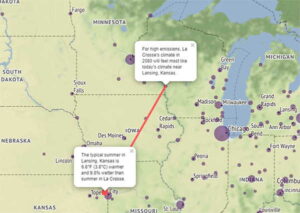
Now available! WICCI scientists have created a mapping tool that answers the question: "What climates today are most similar to the projected future climate of my location?" Also known as climate analogs, these maps show you locations in the U.S. that currently resemble what the climate is projected to be like in Wisconsin in the future. Explore this new feature now.
WICCI climate scientists have "down-scaled" global climate models to project how Wisconsin's climate has been changing and how it might change in the years to come.
Click on the map to activate a slideshow of the recent results of the efforts to map climate change in Wisconsin.